
Ain Lember, Saarte Hääl
Saaremaa dairy invested 2.1 million euros last year, enabling it to produce more and at higher quality, and thereby pay dairy farms a better price for their milk.
Valdis Noppel, chairman of the management board of Saaremaa dairy, said that production was halted for a long time while new equipment was installed, from 25 August to 8 November. “You have to be a little crazy to undertake something like this at all,” said Noppel, according to whom most of the milk was sold outside Estonia during the shutdown. Only the production of butter, quark and drinking milk continued on site, but their volumes are far lower than those of cheese production.
The dairy spent the largest sum on purchasing a third cheese vat with support from PRIA. The investment totals 1.264 million euros, of which 367 thousand euros is grant funding. In addition to the new cheese vat, this investment covered a cheese pre-pressing tower with buffer tanks and a mould washer. Without grant support, the dairy purchased new raw milk tanks for 233 thousand euros, which can hold 60 percent more raw milk. The previous tanks dated back to the last century and were technically outdated.
The cheese production equipment at the Saaremaa dairy was last upgraded in 2008. Adding a third cheese vat significantly increases the cheese line’s production capacity. The dairy can now process 180 tonnes of raw milk a day instead of the previous 140 tonnes. Column pressing has replaced curd-mat pressing, while the pre-pressing vats have been replaced with a tower. According to Noppel, production using the tower is more hygienic because the equipment is easier to wash. As the whey is constantly moving inside the tower, its quality also improves.
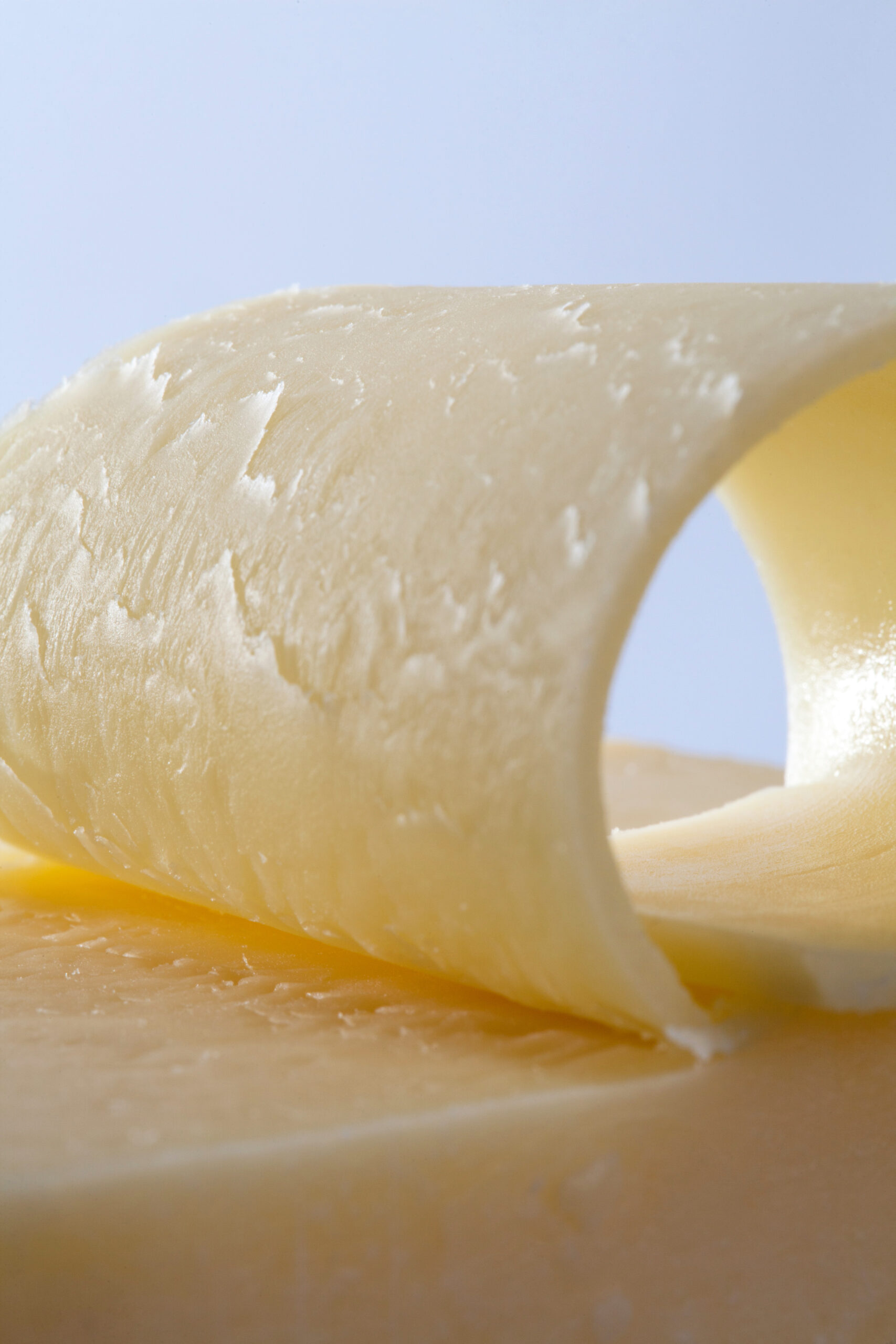
The new technology primarily benefits Saare Leet, the Saaremaa dairy’s only Tilsiter-style cheese, which now has better and more consistent quality. Previously, Saare Leet was made using a pre-press, where the curds were raked by hand and quality varied. Now, the whey is removed using a whey separator before the curds enter processing. This ensures that Saare Leet has a consistently airy, lacy texture. The cheese blocks are more uniform in height, allowing the Saaremaa dairy to sell the standard Euroblock required by export markets, Noppel explained. The improvement in quality also brings better microbiological and chemical parameters, as the new technology helps establish and maintain a uniform moisture level.
As a new cheese variety, the Saaremaa dairy is making a cheese called White Cheddar, which is lighter in colour than ordinary cheddar-style cheese with its usual orange hue. “This is our attempt to produce a cheese close to cheddar,” said Nopple.
The dairy spent 487 thousand euros, of which 176 thousand euros was support from KIK, on installing an integrated energy recovery system for milk and whey production. This allows the dairy to recover and share energy generated within the plant. “Previously, we generated energy specifically to heat or cool products. Now we can use the energy from cold products to cool warm products, and the energy from warm products to heat cold products,” said Noppel. As a result, the company now uses less electricity to cool its products and less steam to heat them.
In recent years, the Saaremaa dairy’s range has expanded to include various fresh dairy products, some of which had never previously been made on Saaremaa. Nevertheless, cheese and butter production remains the dairy’s top priority. “Our income comes primarily from cheese, butter and whey concentrate,” said Noppel. The new equipment purchased last year ensures the quality needed for the cheese to succeed in foreign markets and helps increase export revenue as a share of sales. According to Noppel, the Saaremaa dairy currently sells cheese to various European and Scandinavian countries.
Previously, much of the local output went to Greece and Italy, but the lesson learned from the coronavirus pandemic forced the dairy to expand into more markets. “The pandemic hit us full force precisely because we were so focused on Southern Europe,” Noppel acknowledged. When Greece and Italy were left without tourists because of the pandemic, Saaremaa cheese was no longer needed there, and local dairy farmers felt the impact through low milk prices for two years.
For years, Saaremaa’s dairy farmers have not received payment for their output on time; milk payments have repeatedly been delayed. By the beginning of August, before the dairy’s modernisation began, its financial position allowed it to pay for milk by the agreed date. “We were only two days behind schedule. That was the best position we had been in since I started working here,” said Noppel. Unfortunately, the two-and-a-half-month shutdown affected milk payments, which are now arriving with a longer delay again. Without the intervening shutdown, the dairy would now already be paying for milk on time. Unfortunately, installing new equipment can readily be compared to sending a person for surgery. “If you are put into an induced coma on the operating table, you don’t go to work or go skiing the next day,” said the dairy’s manager. According to him, the setback in milk payments certainly caused resentment among dairy farmers, but the investments ensure that sooner or later milk payments will reach producers’ accounts on time.
Despite the difficult times for dairy farmers, the company’s management decided to carry out the investment plans. “I saw that if the Saaremaa dairy wants to remain a serious cheese producer, we have to change something,” said Noppel. “We cannot carry on indefinitely with the capabilities that were established here for us in 2008.”
Noppel noted that the increased production capacity resulting from the investments gives producers an opportunity to expand their dairy herds. To make full use of the dairy’s potential, produce as efficiently as possible and thereby earn more, the dairy needs milk from mainland producers. At present, the Saaremaa dairy buys raw milk only from Saaremaa and Hiiumaa, said the chairman of the dairy’s management board.