
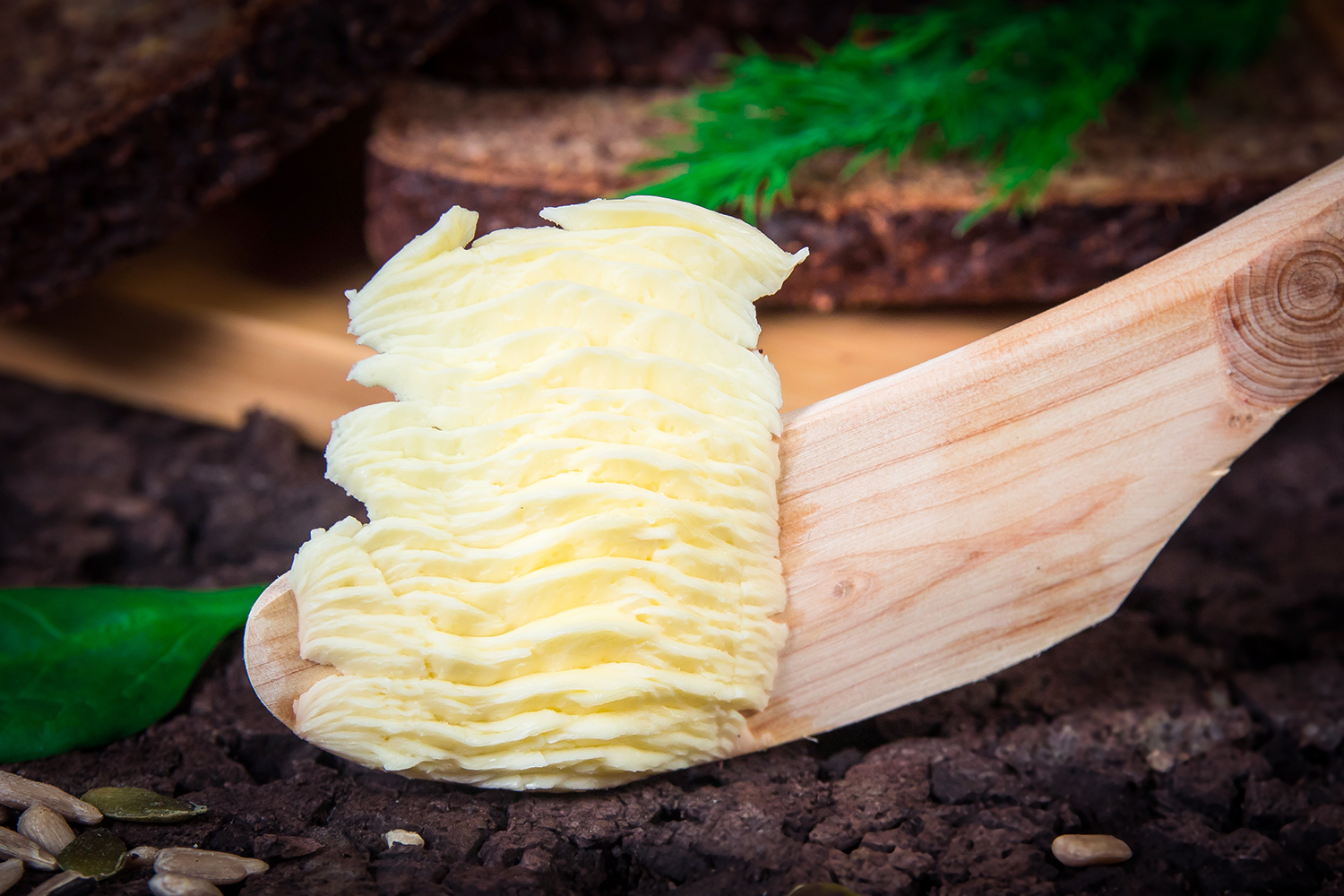
Some types of butter do not qualify as true butter under modern requirements because their fat content is below 80%. For example, sandwich butter produced in the past contained 35% water, while farmhouse butter still sold today contains 25% water.
How is butter made?
Butter is made from sweet or soured cream. A lactic acid bacteria starter culture is added to butter made from sweet cream. Butter production is based on churning the cream, which breaks the membranes of the fat globules and allows their contents to combine. Eventually, larger pieces form and the butter mass separates from the liquid. Buttermilk is produced as a by-product.
Butter is essentially an emulsion of water in milk fat. In terms of its biochemical composition, butter contains at least 80% milk fat and no more than 16% water. Non-fat dry matter accounts for up to 2% of butter’s composition. This last group includes milk proteins, milk sugar, mineral compounds, vitamins, pigments and aroma compounds.
Good-quality butter
It is the milk fats in butter that determine the product’s properties. Good-quality butter must meet two requirements. In warm conditions (at 20–25 C), a piece of butter must still retain its characteristic shape and must not collapse into a shapeless mass. In moderately cool conditions (at 10–15 C), butter must be sufficiently pliable, without becoming brittle or splintering. Butter is recommended to be stored at +2–+6 C, which ensures the product’s quality for at least a month and a half. The main enemies of butter during storage are heat, oxygen and light, which eventually cause the fatty acids to turn rancid and give the butter a bitter taste.
Some types of butter do not actually qualify as true butter under modern requirements because their fat content is below 80%. For example, sandwich butter produced in the past contained 35% water, while farmhouse butter still sold today contains 25% water. A higher water content saves milk fat and also reduces the product’s energy value. Butter with a high water content is not well suited to frying, as it tends to splatter when heated and may eventually even burn. Another risk is the somewhat poorer keeping quality of these products: the more water butter contains, the harder it is to preserve. Butter with a high water content is also difficult to spread when cool. It is true that keeping the packet of butter at room temperature could prevent this, but then rancidity of the butter’s fatty acids becomes a problem.
Butter and fat
From a nutritional perspective, there is no reason to fear the milk fat in butter. Butter fat is readily absorbed from the digestive tract because its fatty acids have a relatively low melting point. Eating a notional serving of butter of 14 grams (for example, on two generously buttered sandwiches or as a larger knob of butter in a bowl of porridge) provides the human body with several necessary nutrients. This amount delivers around 7 g of saturated fatty acids to the digestive tract, which the human body uses very effectively, mainly for energy and structural purposes.
It is worth knowing that these 7 g include nearly a gram of short-chain saturated fatty acids, which the heart muscle needs to function normally under ordinary conditions. At the same time, 14 g of butter also provides our body with 2.4 g of monounsaturated and 0.5 g of polyunsaturated fatty acids, both of which have particularly beneficial effects on bodily functions.
It is also important that all these fatty acids are natural and chemically unmodified, something that not all butter substitutes can boast. A serving of butter this size delivers approximately 30 mg of cholesterol to the digestive tract, of which about a third is absorbed. Yet a person needs at least 250–350 mg of cholesterol from food each day. So there is no problem! Another positive aspect of butter’s composition is the small amount of lecithin it contains. Taking all the above into account, butter’s fat composition is well suited to humans.
As butter consists mainly of milk fat, it is a high-calorie food: eating the previously mentioned 14-gram piece of butter, for example, provides the body with just under 100 kilocalories of food energy. Naturally, the more water butter contains, the lower its calorie content. Some people are wary of eating butter precisely because of its high calorie content. However, butter has several advantages over other fats, such as a more varied natural biochemical composition, a beautiful golden-yellow appearance, a melt-in-the-mouth texture and a pleasantly aromatic scent.
Butter’s composition
Protein is present in butter in relatively small amounts, only around 1%. The rule is that the lower the fat content of butter, the more protein the product contains. However, the favourable amino acid composition of the milk proteins in butter deserves emphasis.
The carbohydrates in butter are mainly present as lactose (milk sugar), but the amount is small, likewise only around 1%. So lactose is not a problem either.
In ordinary butter, we primarily find fat-soluble vitamins A, D and E, but their content depends on the breed of the dairy animal, its living conditions, the season and its feed. Butter also owes its beautiful yellow colour to a fat-soluble pigment: beta-carotene. Its content, too, depends mainly on the cows’ feed. Besides being pleasing to the eye, beta-carotene offers other benefits to humans: our bodies use it to synthesise vitamin A. What is more, this is not the synthetic beta-carotene found in tablets, but natural beta-carotene. The latter has a markedly different spatial structure from the synthetic form and is therefore healthy. Among water-soluble vitamins, traces of some B vitamins are found in butter’s aqueous phase.
Looking for vitamin C in butter, however, is pointless, as it simply contains none, nor is butter intended as a source of it. Butter also contains mineral compounds, but only in small amounts, as most of them have passed into the buttermilk.
How does butter melt?
When melted slowly, butter separates into three layers:
The top layer is a thin layer of foam. This is the water in the butter, which boils off.
The middle layer is melted butter (fat)
and the bottom layer is the dry matter in the butter: proteins and carbohydrates.
The foam that forms when frying butter consists of steam from boiling water and milk proteins. As the water evaporates and little remains, the foam subsides. Whey proteins remain as a film on the surface, while caseins sink to the bottom, forming a sediment. With further heating, the sediment begins to change colour: the darker the colour, the nuttier the flavour.
Butter is not suitable for frying, as its structure begins to break down above 130 degrees. It would be more suitable to use oil + butter.
It is worth knowing that additives are not permitted in genuine butter.